
Global Volumes are now in beta for Serverless endpoints
Attach a Global Volume to a Runpod Serverless endpoint and your workers start in any data center with your GPU types. Store model weights once, read anywhere.
All
 Skip to main content
Blog
With more than half of CLI usage driven by agents, there's strong demand for Runpod's agent-ready infrastructure.


As of the week of August 17, 2026, a little over two months after Runpod shipped its Model Context Protocol (MCP) server, more than half of all runpodctl CLI traffic comes from AI agents. An agent user here means traffic routed through Runpod's MCP server, an agent-tagged CLI command or an agent-tagged SDK request rather than a human working the web console. MCP is the open standard that lets AI agents call external tools and APIs directly.
These numbers read as product demand. The appetite existed well before the features did, visible in how developers were already using Runpod's programmatic interfaces, and the adoption curve measures what happened once the platform met it. This post walks the evidence feature by feature: what users were already doing, what Runpod shipped in response and what the numbers say about how much developers needed it.
The clearest signal in the dataset is the CLI. runpodctl was built for programmatic callers long before anyone was measuring agents, and when agent-attribution tagging landed, a third of its measured traffic was agent-driven within a month. By the week of August 17, agents accounted for more than half of all CLI traffic and roughly half of users who touched the CLI that week drove agent traffic through it. Nobody marketed the CLI as an agent surface. Developers pointed their agents at it because it was the programmatic interface that already existed, and the habit converted on its own. Latent demand does not announce itself in feature requests; it shows up in behavior like this.
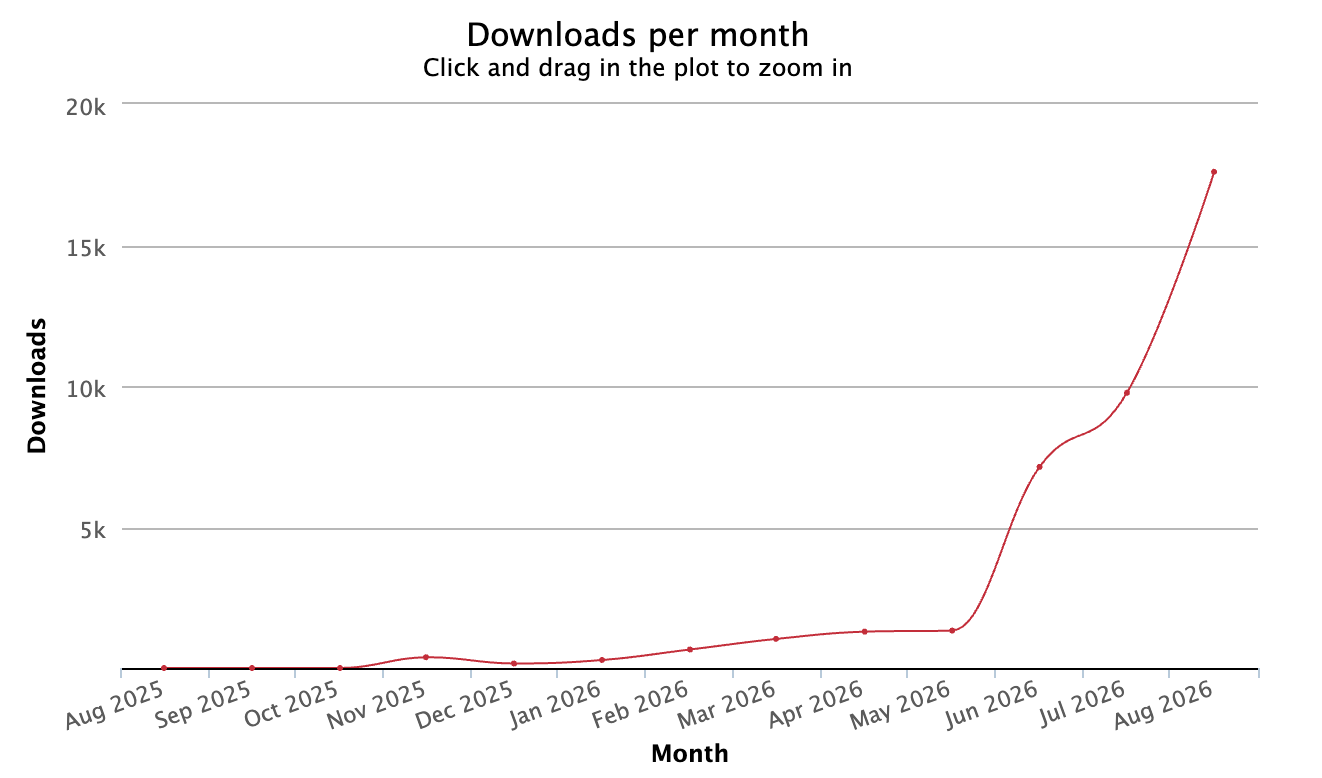
The MCP server tells the same story from the other side, growing every week since its early-June launch, 150x by early August and roughly doubling again since. Downloads follow the same curve on public npm-stat data. One note on measurement first: MCP traffic is agent traffic by definition, CLI and SDK calls count when they carry an agent identifier, and a single agent-attributed request makes someone an agent user for the week, a generous definition the team that built the dashboard flagged itself. The traffic numbers do not have that problem, because a call either came from an agent or it did not, which is why this post leans on request shares and call volumes.
Each feature below answers something users were already doing the hard way, and everything in this section is grounded in the public runpod-mcp repository and the initiative list behind the work.
Each item is ordinary engineering aimed at a need users had already demonstrated. The adoption data later in this post shows what that work has been worth.
The control plane above is half the answer, because an agent also needs somewhere to run the actual work. Agent traffic is bursty by nature: an agent plans, fires a batch of calls, waits on results and bursts again. Agentic AI infrastructure has to absorb that demand curve, which maps far better onto serverless GPU infrastructure that scales from zero than onto reserved capacity you pay to keep idle.
Runpod Serverless was built for that shape, with published FlashBoot cold starts under 200ms covering the infrastructure overhead, and model loading adding time on top. The scale-from-zero case is for bursty work; a steady, high-volume inference load prices out better on reserved capacity.
Pods cover the interactive building, fine-tuning and debugging the same agent orchestrates through the MCP or CLI, because agents do not respect product boundaries: a single session might deploy an endpoint, spin up a pod for a fine-tune and write artifacts to a network volume. On one platform with one account and one credential, that session completes; split across two clouds, it stalls waiting for you to manage them both.
Metrics demonstrate a consistent rise:
Additional weekly metrics reinforce this growth. In the week of August 3, agent calls reached a record 0.53% of API traffic (up 2.5x week-over-week), with agent CLI calls up 2.7x and SDK calls up 3.7%. By the week of August 10, ~7% of Python SDK calls carried agent tags, and nearly 5% of active users accessed the platform via agents (up from 4.2% two weeks prior).
The CLI is the fastest-growing agent channel as developers apply familiar programmatic habits. Steady MCP retention (45–53% week-1, 23–29% long-term) confirms persistent utility rather than a temporary trend.
There's no denying the trend towards increased agent activity when looking at a chart of monthly download statistics for npm @runpod/mcp-server:
Agent usage breakdown by harness reveals key differences: Claude Code led in users across most surfaces (with 38% on MCP), while Codex generated 60% of request volume in the last week. Both have similar user counts on runpodctl. Because high-volume and high-user harnesses stress infrastructure differently, testing against both is critical.
Testing must account for both patterns, as real-world traffic already includes both.
More than 98% of the users who drove agent requests also had manual usage the same week. For nearly every user in this data, an agent is an additional way to touch the platform rather than a replacement for the console or the terminal, which is what running AI agents in production actually looks like today. It also clarifies what users needed: not a separate agent platform to migrate to but agent access to the accounts, pods, endpoints, templates and network volumes they already work with by hand.
That is how AI agent deployment happens in practice, with no parallel account and no replatforming step. Hand your agent the tedious work first, watch it in the console and expand its responsibilities at whatever pace the results earn.
If you are evaluating AI agent infrastructure, the criteria for an agent-ready platform are concrete, and you should apply them to any provider. Ask whether your agent can authenticate without a long-lived key sitting in a config file, whether every every high-frequency v2 operation is exposed as a tool rather than a docs page, whether list operations are capped so a long session survives its own context window, and whether errors come back as stable codes it can branch on. Runpod ships all four today.
The question whoever owns your budget will ask is what stops an agent from spending it overnight. Part of the answer exists at the account level: new Runpod accounts carry a default spending cap of $80/hour that only a human can raise, so an agent cannot run past that ceiling on its own. A ceiling cuts both ways, since a cap that stops a runaway agent can also stall a legitimate overnight batch, so ask any provider a fifth question: what happens when an agent hits the ceiling, and can budget be pre-authorized for planned work. Per-agent limits and approval gates deserve their own post.
The faster path is to stop reading and run npx @runpod/mcp-server@latest add, point your coding agent at the hosted server and ask it to deploy, inspect and tear down a Serverless endpoint. Almost 5% of Runpod's active users already work this way. The caveats in this post are real, and so is the direction. Your agents are going to be provisioning compute soon, if they are not already, and Runpod is built so they can.
Runpod Serverless runs your container as an autoscaling endpoint that scales to zero and bills by the second.
Blog Posts

.jpeg)