How to connect to your Pod with SSH (and move files with SCP and FileZilla)
Lost on how to connect to your pod with SSH? Start here.
All
 Skip to main content
Blog
Start AI Infrastructure 101, a seven-part series covering the platform, lifecycle, and infrastructure decisions behind production AI systems.

Boards ask for an AI strategy, competitors ship AI features and somewhere in the last year the question changed from "should we use AI?" to "why aren't we running it yet?" If you are the person who was handed that question, you have probably discovered the uncomfortable part: the hard decisions are not about AI at all. They are about infrastructure.
This post opens a seven-part series for exactly that person. Over the next several weeks, the series walks the same path a new engineer at a GPU cloud company walks in their first week: how the AI industry got here, what kinds of models exist, why GPUs run them, how model size drives hardware requirements, which GPUs matter and how the data center economy underneath it all actually works. The final part turns that knowledge into a quick-start plan you can run this quarter. Each post stands alone, but read in order they build a complete working model.
The AI conversation is dominated by two groups who talk past each other. Researchers discuss model architectures in academic vocabulary, and cloud vendors discuss instances and endpoints in procurement vocabulary. The manager in the middle needs neither a PhD nor a purchase order. What you need first is a working mental model: what these systems are, what they run on and what the realistic options are for a team that wants results without building a data center. That vocabulary gap is the problem this series solves, and most of it never mentions a vendor.
Twenty years ago artificial intelligence was an academic discipline. Today it sits in the operating plans of banks, hospitals, retailers and studios, and the business case is concrete. AI automates repetitive, data-heavy work at scale. It extracts patterns and predictions from datasets too large for human analysis, powering everything from recommendation engines to fraud detection. It creates competitive advantage through personalization, dynamic pricing and faster product cycles. And it is accelerating scientific discovery in fields like drug development, genomics and climate modeling.
None of that is new as an ambition. What changed is that the technology started working reliably, and the reason it started working is compute.
AI's current prominence is the result of decades of research converging with modern GPU compute and large-scale datasets. Four milestones explain most of the story.
2012: AlexNet and ImageNet. A neural network trained on GPUs crushed the field in an image-recognition competition. This single result triggered widespread GPU adoption for training deep networks and moved deep learning from theory to practice.
2016–2019: the tooling era. DeepMind's AlphaGo beat a world champion at Go and captured public imagination. More practically, frameworks like TensorFlow and PyTorch made it dramatically easier for ordinary engineering teams to build and share models. Enterprise use cases such as predictive maintenance and recommendation systems gained real traction.
2020–2022: the generative boom. GPT-3 demonstrated that a sufficiently large language model could write coherent text, answer questions and draft code. Diffusion models like Stable Diffusion and DALL·E did the same for images. Open-source communities such as Hugging Face democratized access to pretrained models, so small teams could suddenly use state-of-the-art AI.
Beyond GPT-3: scale and specialization. Successive model generations added reasoning ability and multi-modal input, while open-source model families like LLaMA and DeepSeek gave developers transparent, customizable alternatives to proprietary systems. At the same time, techniques like quantization and distillation made smaller, cheaper models viable for focused tasks.
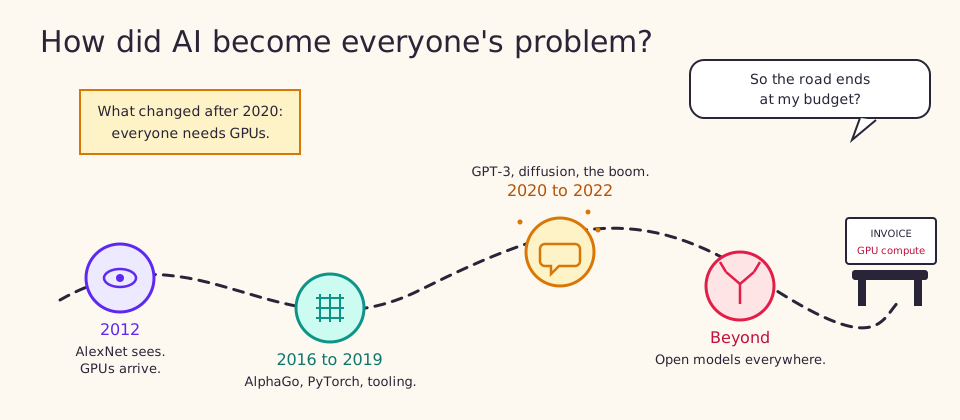
The release of GPT-3 in 2020 pivoted industry attention toward large generative models, and that shift is why infrastructure is now your problem.
Demand for GPU compute exploded. Training large models requires massive parallel compute clusters, and running them in production, which the industry calls inference, is also GPU-intensive whenever request volume is high or responses must be fast.
Enterprises found practical ROI at the same time. Drafting emails, analyzing documents, powering support chatbots and generating code all produce measurable returns, and those returns converted AI from an R&D line item into an operating expense.
Most organizations then discovered they lack in-house GPU capacity. A new category of specialized GPU cloud providers emerged to meet that demand with competitive pricing and flexible, on-demand usage, and that category is where your decisions will play out.
Consider a mid-sized insurance company whose support team handles 40,000 tickets a month. The AI opportunity is obvious: a language model that drafts first-response answers could cut handling time substantially. The model itself might even be free, because capable open-source models are a download away. The real questions are infrastructural. Where will the model run? What will each of the roughly 1,300 drafted responses a day cost to serve? Does the workload need dedicated hardware around the clock, or should capacity scale up during business hours and down to zero at night? The rest of this series answers them.
Next in the series: The Six AI Model Families and What They're Good For, where you learn to classify any AI use case before a vendor conversation starts.
Blog Posts