Model Hub
Call a model by API, or serve open weights on your own endpoint. Every page lists the GPU, the code, and the price.

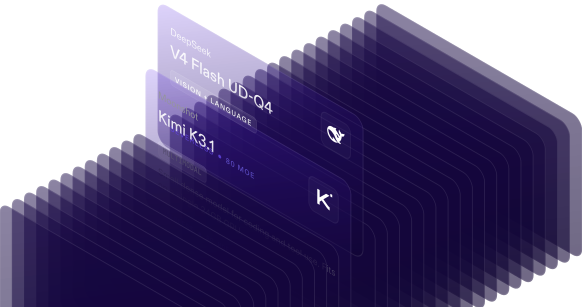
Every modality
Language, vision, image, video and audio models. Each page has the code to call it and a deploy link.
43 Public Endpoints
Call 43 models by API with no setup. Open weights run on your own Serverless endpoint or Pod.
No model matches. Check the full list of deployable models below.
How should I deploy an AI model?
Use Public Endpoints for API access to pre-deployed models. Choose Serverless for your own inference endpoint, Pods for control of a dedicated environment, or Clusters for workloads that span multiple nodes.
Public Endpoints
Call a supported, pre-deployed model through an API.
Use a Runpod API key. Runpod hosts the model.
Runpod manages the model infrastructure.
Usage-based rates vary by model and output type.
Serverless
Serve your own model behind an endpoint.
Deploy a worker image and configure your endpoint.
Flex workers can scale to zero; active workers stay running.
Compute is billed per second while workers run, including startup and idle timeout. Storage is separate.
Pods
Use a custom serving stack, fine-tune, or run persistent workloads.
Configure a dedicated environment and manage the software.
Manage your Pod resources directly.
Compute is billed per second while the Pod runs. Retained storage can still incur charges.
Clusters
Run distributed training or inference across multiple nodes.
Configure your workload on a managed multi-node cluster.
Choose the node configuration for your workload.
Rates depend on GPU type and node count. See current pricing in the linked documentation.
Deployment options vary by model. Check the model page for supported routes, then follow the linked documentation for setup and billing details.
Deploy any open model from Hugging Face
Deploy a compatible open model on Runpod Serverless using its Hugging Face model ID.
Have a model in mind?
No match here either. Paste the Hugging Face ID into a new Serverless endpoint and vLLM will serve it if it supports the architecture.
FAQs
Questions about running open models on Runpod
Any open model you can serve with vLLM or SGLang. This catalog lists the ones we've tested, each with a template and measured costs. For anything else, deploy it from Hugging Face with the vLLM template on Serverless or a Pod.
Use a Public Endpoint to call a pre-deployed model through the Runpod API with no setup. Use Serverless to serve your own endpoint, Pods for a dedicated environment, or Clusters for workloads that span multiple nodes.
Public Endpoints bill at rates set by model and output type. Serverless and Pods bill per second of compute, and each model page shows the starting GPU. Check the model page and the pricing page for current rates.