.jpeg)
How to Deploy OpenJev on Runpod Serverless
Deploy OpenJev, a 27B decision model that returns structured answers and confidence scores, on a Runpod Serverless load balancer endpoint, then send your first request with cURL and Python.
All
 Skip to main content
Blog
Agentic workflows plan, loop, and burst differently than a single model call — here's what that means for the infrastructure underneath.

A year ago, most AI applications were one call to a model. You sent a prompt, you got a completion, you were done. That is not how the interesting systems work anymore. The ones people are building now plan, call tools, check their own output, and loop until the job is finished. Those are agentic workflows, and they behave very differently from a single model call, both in what they can do and in what they demand from the infrastructure underneath.
This is the entry point. It covers what makes a workflow agentic, the patterns you will actually run in production, and why the GPU layer becomes the bottleneck as these systems scale. If you already know the concepts and want the deeper builds, skip ahead to Multi-Agent Orchestration and Architecture and Scaling Multi-Agent Systems.
An agentic AI workflow is one where the model plans its own steps, calls tools, checks its own output, and loops until the job is done, instead of following a fixed sequence someone wrote in advance.
A standard workflow runs a fixed path. Input goes in, a model responds, the path ends. You wrote the steps, the model fills in the blanks.
An agentic workflow hands some of the control to the model. Four capabilities separate the two: tool use (it can call functions, APIs, search, or code execution, not just generate text), memory (it carries state across steps), planning (it decides the order of operations instead of following a hardcoded script), and multi-step execution (it loops, checks progress, and continues until a goal is met or a stop condition trips).
The shorthand: a standard workflow follows your plan. An agentic workflow makes its own.
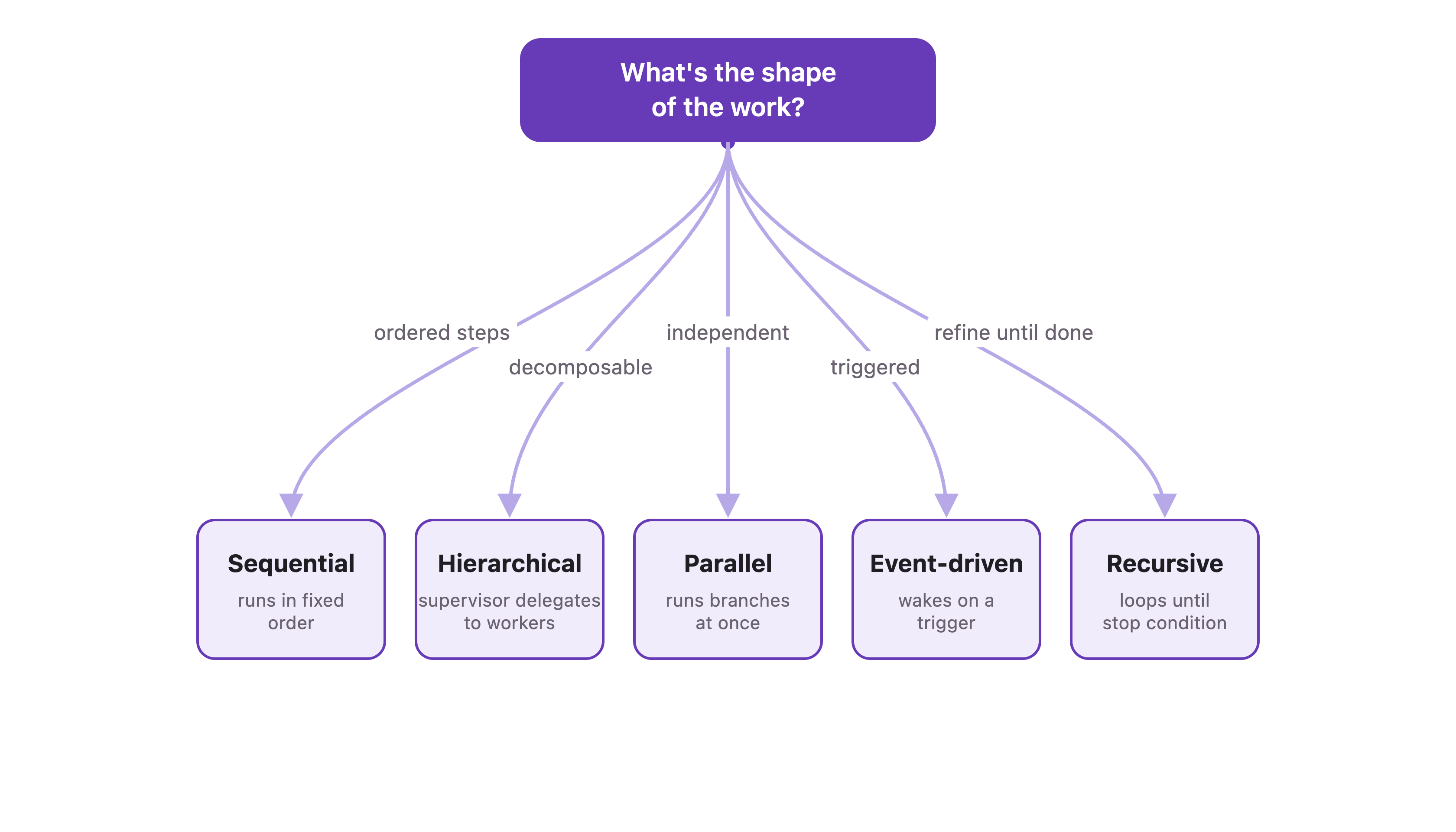
Most agentic systems are a mix of five patterns. Knowing which one you are building tells you how to run it.
A single model call has a predictable cost and duration. An agentic workflow does not. One request might make three tool calls, the next might make thirty. A recursive loop might refine twice or twelve times. A hierarchical run might fan out to twenty parallel workers for one task and one for the next.
So compute demand spikes and collapses inside a single user request, not just across a day. You cannot provision for the average, because the average hides the spikes that break things. And you should not provision for the peak, because you would pay for idle GPUs most of the time.
Bursty, unpredictable, parallel demand is the defining infrastructure trait of agentic AI. It is also the exact shape that dedicated, always-on GPUs handle badly.
Three requirements fall out of that burstiness.
Stateless, horizontally scalable workers. Each step should run on any available worker, so the system can fan out for a parallel or hierarchical step and drop back to zero when done. State lives in your orchestration layer or storage, not pinned to one machine.
Fast cold starts. If new workers take 30 to 120 seconds to come online, autoscaling cannot keep up with a spike that arrives inside a live request.
Real parallelism, billed by use. Parallel and hierarchical patterns only pay off if you can run many workers at once and pay only for the seconds they work.
One split trips people up. The orchestration layer (deciding which agent runs next, routing tool calls, holding state) is CPU work. The model inference each step triggers is GPU work. They scale independently. There is more on that split in Multi-Agent Orchestration and Architecture.
The profile above (stateless workers, fast cold starts, scale to zero, pay per second) is what Runpod Serverless is built for. You deploy your inference step as a Serverless endpoint. It scales from zero to many workers as your agent fans out, and back to zero when the run finishes, so a workflow that spikes to twenty parallel workers for one task costs nothing between runs. FlashBoot keeps cold starts to sub-200ms, so new workers come online fast enough to absorb a spike mid-request instead of stalling it.
Your agent framework (LangGraph, CrewAI, AutoGen, or your own loop) runs the orchestration and points its model calls at the endpoint. The framework does not need to know whether that endpoint is one worker or fifty. That split is the point: your logic stays simple, and the GPU layer handles the burst — scaling up is a continuation of the same setup, not a migration to a different one.
Ready to go further? Deploying and Hosting AI Agents at Scale covers what changes once you're running in production. Or deploy your first agentic workflow on Runpod Serverless.
The cost of an agent is dominated by re-sending the same context every step. Fix that first, then reduce the number of steps.
A workflow where the model plans its own steps, calls tools, checks its own output, and loops until the job is done, rather than following a fixed sequence a person wrote in advance.
Sequential, parallel, hierarchical, event-driven, and recursive. Sequential runs steps in order; parallel runs independent subtasks at once; hierarchical fans a task out to worker agents through a supervisor; event-driven wakes on a trigger instead of a schedule; recursive loops on its own output until a condition says stop.
Because compute demand spikes and collapses inside a single request. One call might trigger three tool calls; the next might trigger thirty. That burstiness is what breaks infrastructure built for a steady, predictable load.
Stateless, horizontally scalable workers; cold starts fast enough to absorb a spike mid-request; and real parallelism billed by the second, not by the hour.
Blog Posts